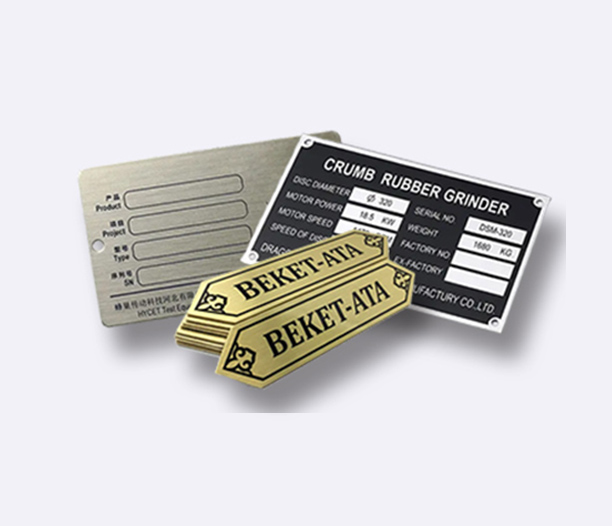
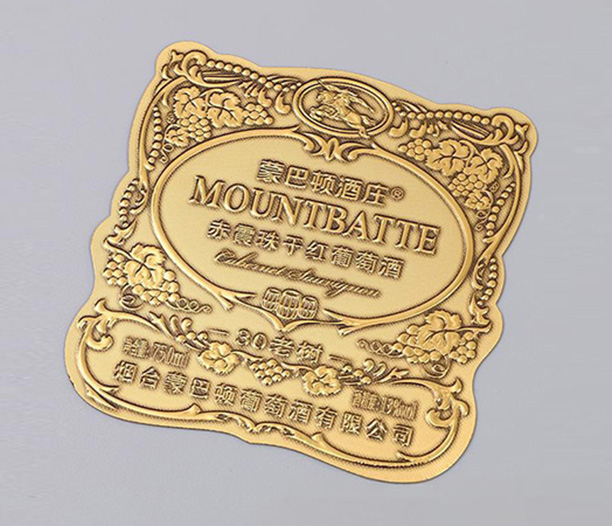
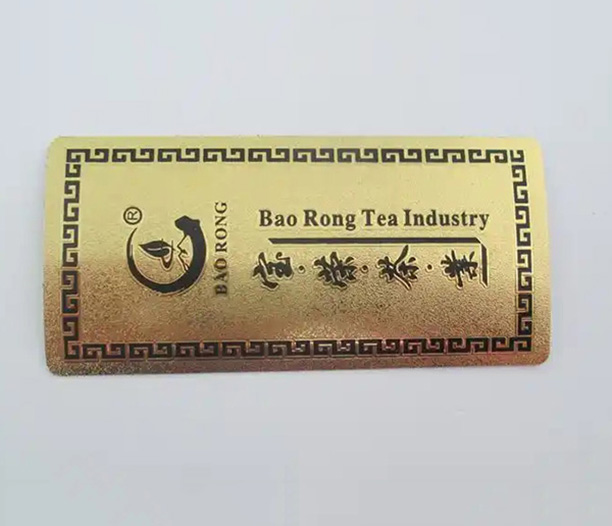
7 Critical Factors for Selecting High-Performance Serial Number LabelsIn manufacturing, aerospace, energy, and heavy equipment, the humble serial number labels serve as the backbone of traceability, maintenance history, and regulatory compliance. A failed or illegible label can disrupt supply chains, invalidate warranties, and trigger costly non-compliance penalties. This guide dissects the seven engineering considerations that separate a durable, reliable identification system from one that fails in the field. Drawing on decades of experience in extreme-environment marking, Hemawell Nameplate provides solutions that withstand harsh chemicals, temperature extremes, and mechanical abrasion.
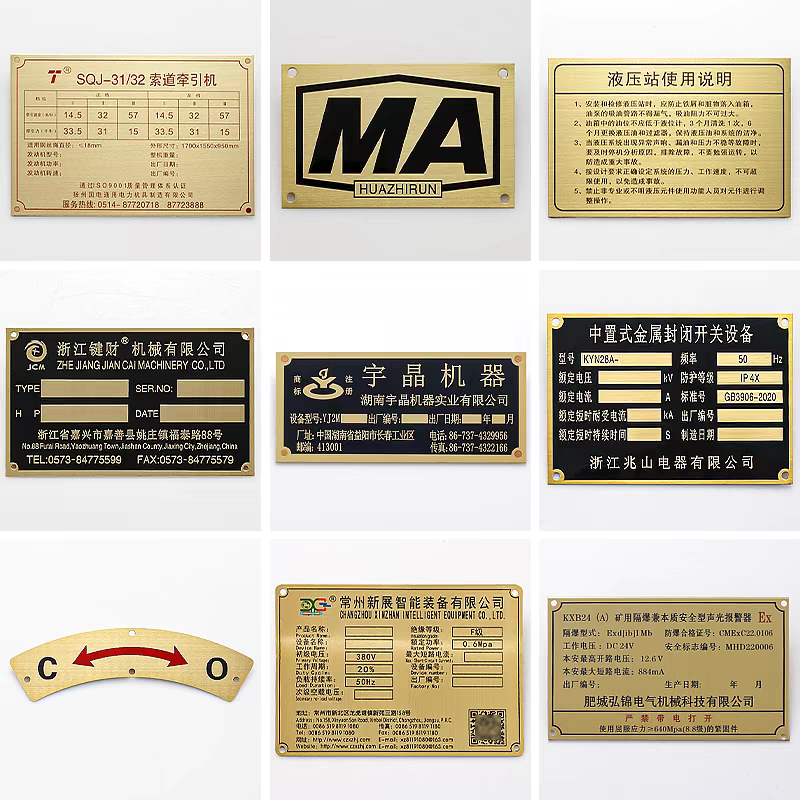
1. Material Substrate: Matching Chemistry to the Operating Environment
The base material of serial number labels determines their resistance to heat, solvents, UV radiation, and physical wear. No single material suits all applications; selection must be based on empirical data from the installation environment.
Metal Labels for Extreme Conditions
Anodized aluminum labels offer excellent durability for indoor industrial use, resisting abrasion and mild chemicals. For environments exceeding 300°F (150°C) or involving aggressive solvents, stainless steel (304 or 316) is preferred. Stainless steel tags, often laser-marked, can withstand temperatures up to 2,200°F and are immune to most industrial cleaners. Hemawell Nameplate manufactures metal labels with photo-anodized or direct laser engraving, ensuring that the data remains legible for the life of the asset.
Polymer-Based Labels
Polyester (PET) and polyimide films provide flexibility and conformability for curved surfaces. Polyimide is particularly suited for circuit board tracking, as it withstands wave soldering. For outdoor UV exposure, polyester with acrylic adhesive and UV-topcoat is a cost-effective choice. However, these materials typically degrade above 500°F, so they are unsuitable for high-heat applications.
2. Adhesive Chemistry: Ensuring Permanent Bonding on Difficult Surfaces
Even the most robust label will fail if the adhesive does not maintain bond strength under service conditions. The adhesive must be selected based on surface energy, temperature range, and exposure to moisture or chemicals.
High-Temperature Acrylics and Silicones
For applications up to 300°F, cross-linked acrylic adhesives provide high shear strength and solvent resistance. For temperatures exceeding 500°F, silicone-based adhesives are required, though they have lower initial tack. Testing per ASTM D3330 (peel adhesion) and ASTM D3654 (shear adhesion) is essential to validate performance.
Surface Energy Considerations
Low-surface-energy plastics (polyethylene, polypropylene) require aggressive adhesives with special tackifiers. Powder-coated surfaces also demand adhesives formulated to bond with textured coatings. Hemawell Nameplate offers adhesive consultation and can pre-test label assemblies on customer-provided material samples to guarantee bond permanence.
3. Data Encoding: Selecting the Right Symbology for Scan Reliability
Modern serial number labels often carry machine-readable codes to automate data capture. The choice of barcode or 2D symbology affects scan speed, error correction, and data capacity.
Linear Barcodes vs. 2D Data Matrix
Code 128 or Code 39 linear barcodes are widely used but require a quiet zone and can only store up to 48 characters. For dense data or small spaces, Data Matrix (ECC 200) is superior. It can encode up to 2,335 alphanumeric characters in a 10x10 mm square and includes error correction that allows decoding even if up to 30% of the code is damaged. QR Codes are also used but require larger surface area for the same data density.
Human-Readable Backup
Even with robust scanning, a human-readable serial number should be present as a fallback. Font size and contrast must be specified according to ANSI MH10.8.2 standards to ensure legibility under low-light conditions. Hemawell Nameplate combines laser-etched 2D codes with high-contrast human-readable text, both engineered to survive decades of environmental stress.
4. Durability Validation: Testing Protocols That Matter
Specifying serial number labels requires evidence of performance under real-world stressors. Reputable suppliers provide test data aligned with industry standards.
Abrasion and Chemical Resistance
Taber abrasion (ASTM D4060) measures resistance to mechanical wear. For chemical resistance, the label should be immersed in representative fluids (oils, solvents, cleaners) for specified durations and then checked for legibility and adhesion. MIL-STD-810 testing is common for defense and aerospace applications.
Weathering and UV Stability
Outdoor labels must pass accelerated weathering (ASTM G154) to simulate years of sun exposure. Without UV-stable materials and inks, serial numbers fade and become unreadable. Hemawell Nameplate offers labels that have passed 5-year Florida exposure tests with no significant color change or loss of adhesion.
5. Integration with Asset Management Systems
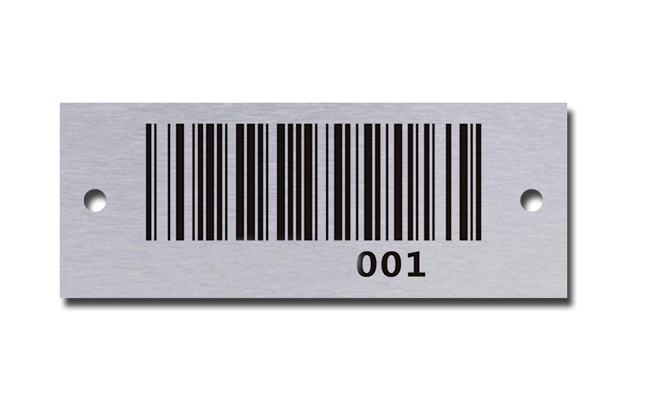
A serial number label is only useful if its data can be seamlessly captured and integrated into enterprise software. This requires consideration of code placement, scanning hardware, and data formatting.
Scanning Hardware Compatibility
Industrial handheld scanners (e.g., from Zebra, Honeywell) must be able to read the chosen symbology under the expected lighting and distance. For 2D codes, imagers are required, whereas laser scanners are sufficient for linear barcodes. Facilities should verify that their existing equipment supports the label’s code type before large-scale deployment.
ERP and CMMS Integration
When a label is scanned, it should trigger a lookup in the Enterprise Resource Planning (ERP) or Computerized Maintenance Management System (CMMS). The label should encode a unique identifier that matches a database record without ambiguity. Standardizing on a data format (e.g., GS1-128) ensures interoperability across different systems and locations.
6. Anti-Counterfeiting and Traceability Features
In industries like aerospace, medical devices, and defense, serial number labels must also serve as anti-counterfeiting tools. Counterfeit parts with forged labels can lead to catastrophic failures.
Covert and Overt Security Elements
Overt features include holographic overlays, color-shifting inks, or microtext that is difficult to replicate. Covert features may involve UV-fluorescent inks, encrypted data within the 2D code, or tamper-evident constructions that leave a void pattern if removed. Hemawell Nameplate offers a range of security laminates and custom encryption services that make duplication nearly impossible.
Supply Chain Chain-of-Custody
Each label’s production can be logged with batch numbers and shipping data, allowing customers to verify authenticity via a secure portal. This adds an extra layer of protection against gray-market infiltration.
7. Customization Complexity and Lead Time Management
Industrial users often require custom sizes, pre-printed logos, sequential numbering, or specific adhesive patterns. Balancing these needs with production lead times and minimum order quantities is a critical procurement factor.
Variable Data Printing vs. Batch Runs
For high-volume applications with sequential serial numbers, digital printing or laser marking allows each label to be unique without tooling charges. For smaller runs, thermal transfer printing on blank stock may be economical. However, thermal transfer labels may have lower durability than etched metal.
Supplier Qualification
Partner with a supplier that has robust quality management (ISO 9001) and the ability to provide certificates of conformance. Hemawell Nameplate offers rapid prototyping and just-in-time delivery, with all materials sourced from certified vendors to ensure consistency across orders.
Conclusion: Engineering Certainty into Every Label
Selecting the right serial number labels is a multidisciplinary decision that impacts operational efficiency, safety, and brand reputation. By evaluating materials, adhesives, data encoding, and compliance with industry standards, organizations can avoid the hidden costs of label failure. As a partner with deep expertise in harsh-environment identification, Hemawell Nameplate provides engineered solutions that deliver permanent traceability. Whether your assets reside in a cleanroom, an offshore platform, or a desert mine, the right serial number label ensures that critical data is always accessible.
Frequently Asked Questions About Serial Number Labels
Q1: What are serial number labels typically made of?
A1: Common materials include anodized aluminum, stainless steel, polyester (PET), and polyimide. Aluminum is used for general industrial applications; stainless steel for extreme heat and chemicals; polyester for outdoor use; polyimide for electronics that undergo soldering.
Q2: How do I choose the right adhesive for my application?
A2: Consider the surface material (metal, plastic, powder-coat), temperature range, and chemical exposure. For high temperatures (>300°F), use silicone adhesives. For low-surface-energy plastics, use aggressive acrylics with high tack. Always request adhesion test data from your supplier.
Q3: Can serial number labels be applied on curved or rough surfaces?
A3: Yes, thin flexible labels (polyester or vinyl) conform to curved surfaces. For rough textures, thicker metal tags may need mechanical attachment (rivets, screws) instead of adhesive. Hemawell Nameplate offers both adhesive-backed and mechanically fastened options.
Q4: Are 2D barcodes better than traditional 1D barcodes on serial number labels?
A4: 2D codes (Data Matrix, QR) store more data in less space and include error correction, making them ideal for small or potentially damaged labels. 1D barcodes are simpler and sufficient for applications with limited data and clean environments.
Q5: What information is usually encoded on a serial number label?
A5: At a minimum, a unique serial number. Often also include part number, manufacturing date, batch code, and URL for product registration. In regulated industries, UDI (Unique Device Identification) or GS1 identifiers are required.
Q6: How can I verify that my serial number labels will last outdoors?
A6: Request accelerated weathering test reports (ASTM G154) or real-time outdoor exposure data. Look for labels specifically rated for UV resistance, with inks and adhesives formulated for long-term sunlight exposure.
Q7: Do you offer custom shapes and colors for serial number labels?
A7: Yes, Hemawell Nameplate provides fully customized labels—any shape, color, and pre-printed graphics. We can match Pantone colors and die-cut to your specifications, with minimum order quantities tailored to project needs.