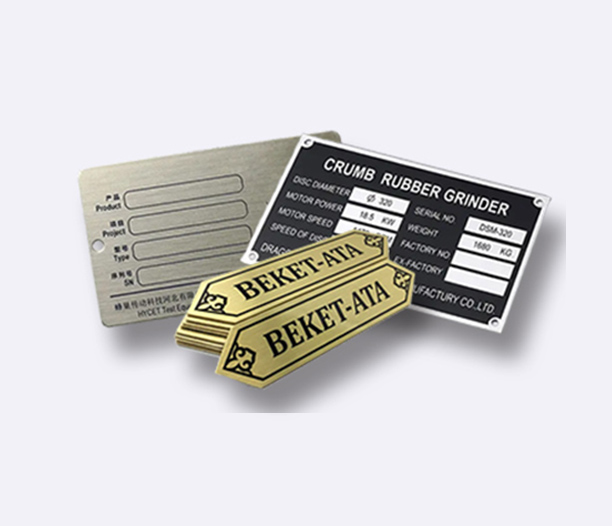
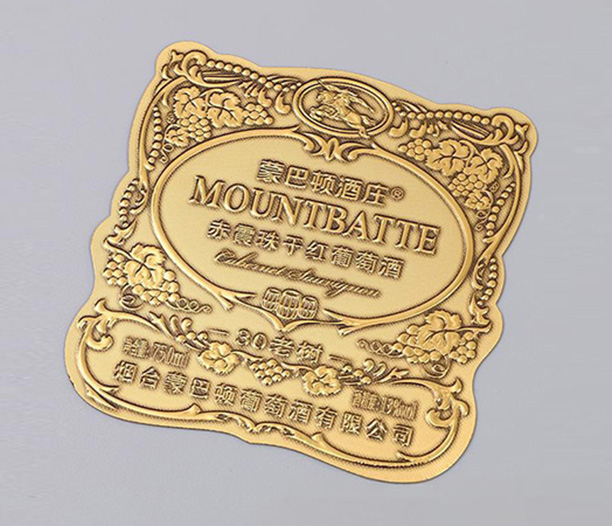
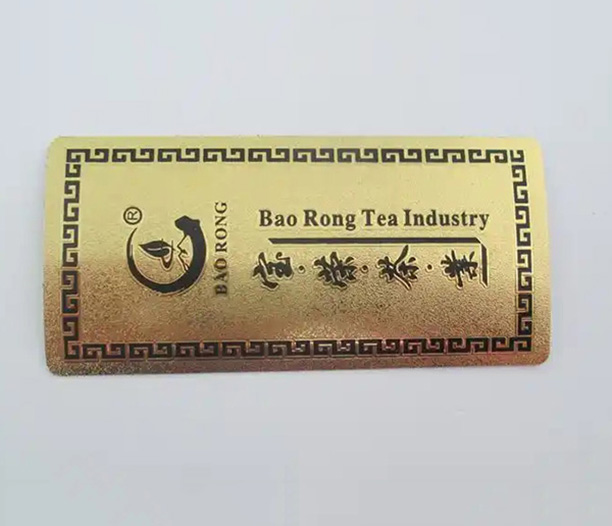
7 Critical Factors for Specifying High-Performance Blank Aluminium Tags | HemawellIn industrial environments, the identification of assets, components, and safety hazards relies on durable media.
Blank aluminium tags serve as the foundational substrate for countless tracking, compliance, and branding applications. While they may appear to be a commodity item, the engineering behind a tag that survives decades in petrochemical plants, aerospace applications, or marine environments is highly specific. This article provides a technical deep-dive into the selection, customization, and application of these essential industrial components, based on metallurgical data and field performance requirements.
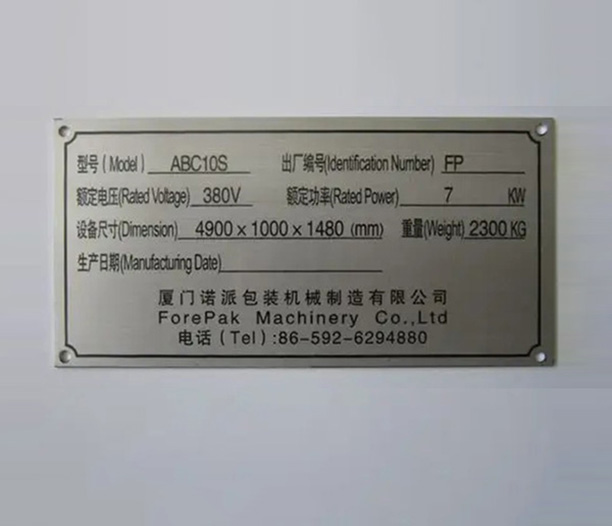
1. Material Science: Why 5000-Series Alloys Dominate for Blank Tags
The performance of a blank aluminium tag begins with its alloy. Not all aluminium is created equal. For industrial nameplates, the 5000-series alloys (primarily 5052) are the industry standard due to their exceptional corrosion resistance, formability, and weldability. These alloys contain magnesium as the primary alloying element, providing a high strength-to-weight ratio and excellent performance in marine or chemical atmospheres. In contrast, 1100-series commercially pure aluminium, while cheaper, lacks the mechanical strength for stamping or the fatigue resistance required for vibrating equipment. When specifying tags, requesting a Mill Test Report (MTR) that certifies the alloy and temper (such as H32) ensures you receive material that will not crack during embossing or corrode prematurely in the field.
2. Technical Specifications: Thickness, Temper, and Surface Finish
Engineers must specify three critical parameters beyond the alloy:
Thickness (Gauge): Standard thicknesses range from 0.5 mm (0.020") for light-duty interior tags to 1.6 mm (0.063") for heavy-duty outdoor valve tags. Thicker gauges resist bending from impact or vandalism.
Temper: A half-hard temper (H32 or H34) is optimal. It is ductile enough for embossing or stamping yet stiff enough to hold its shape under tension. Full-hard (H18) materials can fracture during die-cutting.
Finish: Mill finish offers a reflective, as-rolled surface. For laser engraving or high-resolution barcode printing, a matte anodized finish is required to prevent glare and provide a durable, scratch-resistant ink-receptive layer. Satin or brushed finishes are often specified for aesthetic architectural nameplates.
3. Critical Applications Across Heavy Industries
Different sectors utilize blank aluminium tags for specific compliance and operational reasons. Hemawell Nameplate supplies these critical components globally, and we observe distinct patterns in their usage:
Oil & Gas (Upstream and Downstream): Tags must withstand H₂S (sour gas) and salt spray. 5052 aluminium with a protective anodized coating is standard for valve tags and line markers, often meeting NACE MR0175 requirements for sour service.
Aerospace & Defense: Anodized aluminium tags are used for asset tracking of ground support equipment (GSE) and tooling. They must resist hydraulic fluids (Skydrol) and comply with AS9100 traceability standards.
Chemical Processing: Resistance to alkalis and solvents is paramount. Blank tags are often tested via immersion to ensure the substrate does not react with the chemicals present in the facility.
Telecommunications & Infrastructure: Aluminium tags are non-magnetic and can be attached to sensitive equipment without interfering with electronics. They are used for fiber optic cable identification and utility pole markers.
4. The Strategic Advantage of "Blank" Inventory for Variable Data
Why would a facility purchase blank aluminium tags rather than pre-printed ones? The answer lies in flexibility and just-in-time (JIT) data application. Facilities with on-site marking capabilities (dot peen, laser, or hydraulic presses) can keep a stock of certified blanks. When a new pump is installed or a valve is replaced, they can immediately generate a tag with the correct serial number, barcode, or date code without waiting for a supplier lead time. This is critical for maintenance work orders and reducing equipment downtime. Blanks designed for thermal transfer printing often feature a special polymer coating over the aluminium to accept resin ribbons, creating a durable image under the anodized layer.
5. Industry Pain Points and Field Failure Analysis
Selecting the incorrect blank tag leads to operational failures. Based on forensic analysis of returned tags, three primary failure modes are prevalent:
Galvanic Corrosion: Attaching an aluminium tag directly to a stainless steel or copper surface without an insulating barrier (like plastic washers or specific gaskets) creates a galvanic cell. In the presence of an electrolyte (rainwater), the aluminium sacrifices itself, corroding rapidly.
Legibility Loss: Using a non-anodized blank for inkjet or thermal printing. The inks cannot anchor to the soft oxide layer and abrade away within months. The solution is specifying a hard-coat anodized surface with a pore structure designed for ink absorption.
Mechanical Brittleness: Attempting to stamp data into a fully hardened (H18) tag often results in cracking around the characters, leading to broken edges that can snag on clothing or wiring.
6. Comparative Analysis: Aluminium vs. Alternatives
To justify the specification of aluminium, a comparative matrix is useful:
Blank Aluminium Tags vs. Stainless Steel: Aluminium is lighter, easier to emboss, and significantly less expensive. It is preferred where moderate strength and corrosion resistance are required without the weight penalty. Stainless steel is specified for extreme temperatures above 400°C or where maximum mechanical strength is needed.
Blank Aluminium Tags vs. Polyester (Metalized): Polyester tags are cheaper and flexible, but they lack the rigidity for mechanical attachment (rivets) and are susceptible to UV degradation and delamination in high-heat environments. Aluminium provides a permanent, rigid, and heat-dissipating substrate.
Blank Aluminium Tags vs. Brass: Brass offers a premium aesthetic but tarnishes and is heavier. Anodized aluminium maintains its appearance longer in outdoor settings without polishing.
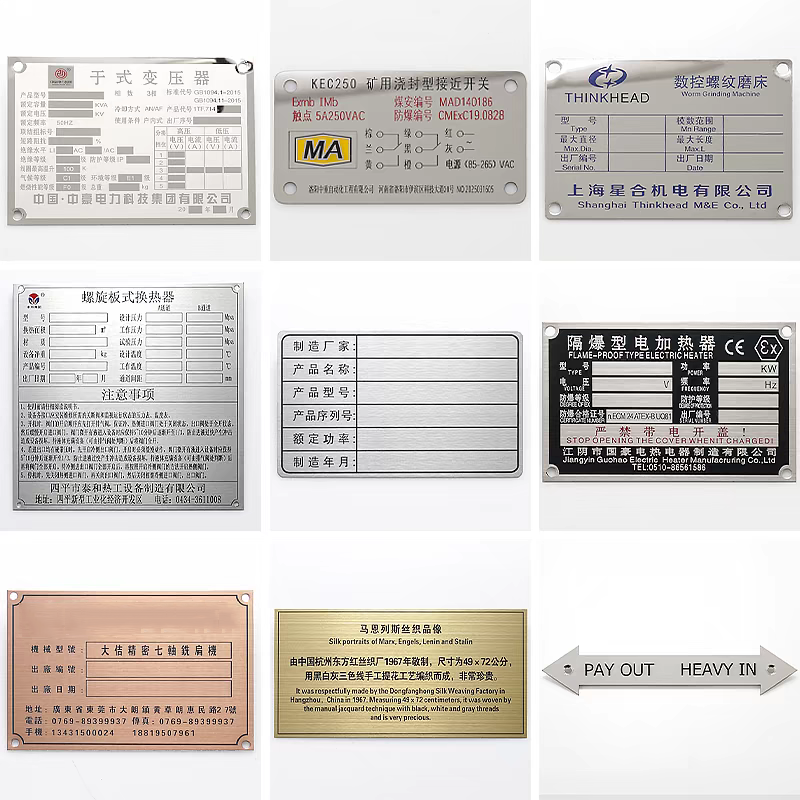
7. Customization Parameters: From Raw Blank to Finished Nameplate
Working with a manufacturer like Hemawell Nameplate allows engineers to define the blank's parameters before any data is applied. Customization options include:
Pre-Cutting: Blanks can be supplied as individual rectangles, circles, or custom shapes with rounded corners and de-burred edges, ready for immediate use.
Hole Punching: For rivet or screw mounting, blanks can be pre-drilled or punched with countersunk holes to ensure flush mounting.
Surface Treatment: Beyond anodizing, chemical film (Alodine/Chem film) is specified for applications requiring electrical conductivity while maintaining corrosion resistance.
Adhesive Backing: For applications where drilling is not permitted, high-bond acrylic foam tapes (such as 3M™ VHB™) can be pre-applied to the blank tags, ensuring a permanent bond to clean surfaces.
8. Compliance and Industry Certifications
For regulated industries, blank aluminium tags must meet specific standards. For instance, safety tags used in hazardous locations may require the material composition to be non-sparking. Aluminium is inherently non-ferrous, making it suitable for Zone 1/21 areas. Furthermore, tags destined for the European market must comply with RoHS and REACH regulations, restricting heavy metals in any applied coatings. Manufacturers must provide material declarations to support the end-user's equipment certification (e.g., CE or ATEX). Always verify that your supplier can provide traceability to the original ingot.
9. Installation Engineering: Matching Fasteners to Environment
The longevity of a blank aluminium tag is heavily dependent on its installation method. Using incompatible fasteners is a common error:
For Marine Environments: Use 316 stainless steel rivets or nylon/plastic rivets to completely isolate the tag from dissimilar metals.
For High-Temperature Applications: Adhesives fail. Mechanical fastening with monel or stainless steel straps is required.
For Vibration-Prone Assets: Use a staked-on or riveted installation with a serrated shank to prevent rotation. Adhesive alone can shear under continuous vibration.
Conclusion: Partnering for Precision and Reliability
Selecting the correct blank aluminium tag is a technical decision that impacts safety, maintenance efficiency, and regulatory compliance. By focusing on alloy, temper, finish, and application-specific data, engineers can eliminate the common failure modes associated with industrial identification. With over 15 years of experience supplying tags to 30+ countries, Hemawell Nameplate provides the material expertise and customization capabilities required for the most demanding environments. We invite you to consult our engineering team to validate your material selection and ensure your next batch of tags performs for the life of your asset.
Frequently Asked Questions (FAQ)
Q1: Can blank aluminium tags be used outdoors in coastal climates without failing?
A1: Yes, provided you specify a marine-grade alloy (such as 5052-H32) and a protective finish like heavy-duty anodizing. The anodized layer acts as a barrier to chloride penetration. For maximum longevity, combine the tag with nylon mounting hardware to prevent galvanic corrosion.
Q2: What thickness is recommended for laser engraving variable data?
A2: For laser engraving, a thickness of 0.8 mm to 1.0 mm is typical. This provides enough material mass for the laser to create a deep, contrasting mark without warping the tag. A matte anodized or coated surface yields the highest contrast for fiber lasers.
Q3: Are your blank aluminium tags compatible with thermal transfer printers?
A3: We supply tags specifically designed for thermal transfer. These are not raw aluminium; they feature a specialized topcoat or an anodized layer that accepts wax/resin ribbons. Standard raw mill-finish blanks will not reliably hold the image and will smudge. Please specify "printable" blanks when ordering.
Q4: How do I choose the right adhesive for my aluminium tags?
A4: The choice depends on the surface energy and temperature. For smooth, high-surface-energy materials like painted steel, an acrylic foam tape (e.g., 3M VHB) provides permanent bond strength. For low-surface-energy or textured surfaces like concrete or wood, a rubber-based adhesive or mechanical fastening is superior. Always request a tape data sheet to verify temperature limits.
Q5: Do you offer blank aluminium tags pre-cut to non-standard shapes or with specific hole patterns?
A5: Absolutely. As a custom manufacturer, Hemawell Nameplate routinely supplies blanks in custom geometries, with de-burred edges, and drilled or punched mounting holes to your exact specifications. This eliminates secondary operations and ensures a perfect fit for your equipment.
Q6: What is the maximum temperature rating for anodized blank aluminium tags?
A6: The aluminium substrate itself can withstand continuous temperatures up to approximately 400°F (204°C) before losing significant strength. The anodized coating is integral and will not peel or delaminate within this range. However, any applied paint, ink, or adhesive backing will have a much lower temperature limit—typically around 300°F (150°C) for specialty inks.