In the utility sector, the humble electric meter
tags serves as the primary identifier linking a physical meter to
billing systems, maintenance records, and regulatory compliance. Far more than a
simple label, these tags must endure decades of outdoor exposure—UV radiation,
temperature extremes, moisture, and physical abrasion—while retaining scannable
barcodes and human-readable text. They also act as a first line of defense
against tampering and energy theft. This article provides a technical deep dive
into the engineering, material science, and industry standards governing
electric meter
tags, offering procurement and engineering professionals a
framework for selecting tags that reduce operational risk and total cost of
ownership. With insights drawn from decades of custom nameplate manufacturing,
including the specialized capabilities of Hemawell Nameplate, we
examine how to balance longevity, readability, and security in field-deployed
meter identification.
Material Science for Outdoor Meter Identification
The operational environment for an electric meter is one of the most
demanding for any identification tag. Mounted on residential homes, commercial
buildings, or substations, tags face continuous UV exposure, temperature swings
from -40°C to +80°C, rain, snow, and salt-laden air in coastal regions. The
choice of substrate and marking method directly determines the tag’s functional
lifespan.
Film Substrates: Polyester, Polycarbonate, and Vinyl
For most utility applications, 2-mil to 4-mil polyester (PET) films with
acrylic adhesives offer an excellent balance of conformability and durability.
Polyester is dimensionally stable and resistant to solvents commonly used in
meter cleaning. Polycarbonate provides higher impact resistance but can yellow
under extended UV exposure unless stabilized. Vinyl (PVC) is cost-effective but
degrades more rapidly outdoors; it is generally specified only for indoor or
short-term applications. To meet utility specifications, tags often require UL
969 certification for adhesion and legibility after environmental exposure.
Metal Tags for Extreme Conditions
In high-temperature environments (e.g., near transformers) or where vandalism
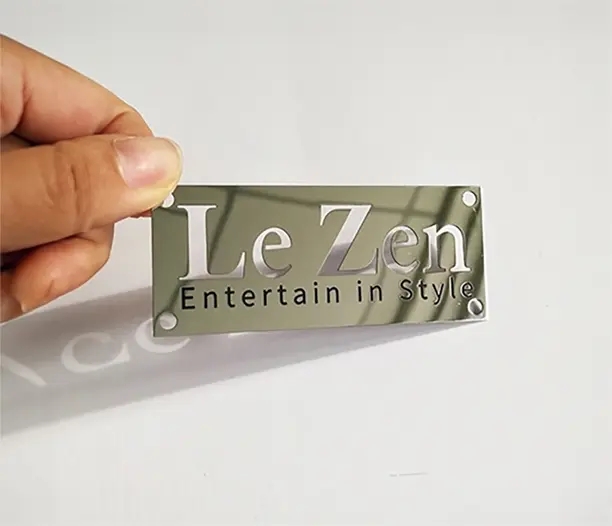
is a concern, anodized aluminum or stainless steel tags are specified. These are
typically marked by dot peening, laser engraving, or electrochemical etching.
While more expensive, they offer lifespans exceeding 20 years. Hemawell Nameplate produces
laser-marked stainless steel meter tags for offshore wind farm meters, where
salt spray and vibration are constant challenges.
Adhesive and Lamination Strategies
The adhesive must bond to the meter’s surface—often powder-coated aluminum or
engineering plastics. Permanent acrylic adhesives are standard, but for
low-surface-energy plastics (like polycarbonate meter covers), a high-tack
rubber-based adhesive or mechanical fastening (cable ties, rivets) may be
required. A clear polyester overlaminate protects printed graphics and barcodes
from abrasion and chemical attack, and UV-stable overlaminates are essential to
prevent yellowing.
Data Encoding: Barcodes, QR Codes, and OCR Readability
Modern electric meter
tags must support both human-readable and machine-readable data.
Utility companies often manage millions of meters, so automated data capture via
barcode scanning is critical for inventory, installation, and meter reading
workflows.
Barcode Symbologies and Quality Standards
Code 39 and Code 128 are common linear barcodes for meter serial numbers.
However, 2D symbologies like Data Matrix or QR codes are gaining ground because
they pack more data (e.g., manufacturer, model, firmware version) into a small
space. Barcode print quality must meet ISO/IEC 15416 (linear) or 15415 (2D)
standards; a grade of C or higher is typically required by utilities. Thermal
transfer printing with resin ribbon on polyester provides the necessary
durability and contrast.
OCR-A Fonts and Human-Readable Text
For manual reading, ANSI standard OCR-A font ensures consistent character
recognition by both humans and optical scanners. Character height must be at
least 3/16” (4.8 mm) for legibility from a distance. High-contrast color
combinations (black text on white or silver background) are preferred. Some
utilities also require color-coding (e.g., red border for high-voltage meters)
for quick visual identification.
RFID Integration
Some advanced meter tags embed passive UHF RFID inlays, enabling contactless
reading of meter data. The challenge is that the meter’s metal housing can
detune the antenna. Special on-metal RFID tags use a ferrite layer to isolate
the inlay from the metal, and these can be encapsulated in a durable plastic or
metal housing. While cost is higher, RFID automates inventory and eliminates
line-of-sight requirements.
Security Features: Anti-Tampering and Theft Deterrence
Energy theft costs utilities billions annually. electric meter
tags play a crucial role in deterring and detecting tampering.
Security features can be overt, covert, or forensic.
Destructible and Tamper-Evident Constructions
Tamper-evident tags are designed to fracture or leave a "void" pattern if
removal is attempted. These tags use a fragile face stock and a high-tack
adhesive that causes the tag to delaminate upon peeling. Some designs
incorporate a series of slits that make the tag break into small pieces if
moved. Destructible vinyl is commonly used for meter seals.
Covert Security Features
To authenticate genuine tags, utilities can specify covert features like
microtext (text visible only under magnification), UV-fluorescent inks
(invisible under normal light), or taggants (microscopic particles with unique
spectral signatures). These features make counterfeiting difficult and allow
field inspectors to quickly verify authenticity.
Unique Serialization and Database Tracking
Each tag should carry a unique, non-repeating serial number. When combined
with a secure database that records which meter receives which tag, any attempt
to swap a tag is detectable. High-security applications may use cryptographic
signatures encoded in a 2D barcode that can be verified with a mobile app.
Regulatory Compliance and Industry Standards
Utilities operate under strict regulatory oversight. Meter tags must comply
with standards set by ANSI, IEC, and local metering authorities.
ANSI C12.10 (Physical Aspects of Watthour Meters) –
Specifies the marking requirements, including location, size, and content of
meter nameplates.
IEC 62052-11 (Electricity metering equipment – General
requirements) – Defines marking and durability tests, including resistance to
heat and fire.
UL 969 (Marking and Labeling Systems) – Provides test
methods for adhesion, abrasion, and environmental exposure. A UL-recognized tag
ensures the label will not peel or fade prematurely.
MID (Measuring Instruments Directive) 2014/32/EU – For
meters sold in Europe, tags must bear the CE mark and supplementary metrology
information.
Hemawell
Nameplate maintains a quality management system certified to
ISO 9001:2015 and regularly tests its meter tags to these standards, providing
customers with documentation for regulatory audits.
Overcoming Field Challenges: Fading, Peeling, and Illegibility
Despite best intentions, many utilities experience premature failure of
electric meter
tags. Here are common failure modes and their engineering
solutions.
UV Fading and Yellowing
Over time, UV radiation can fade text and turn overlaminates yellow, reducing
barcode contrast. Solution: Use UV-stable polyester films and UV-resistant
inks/ribbons. Accelerated weathering testing (ASTM G154, 2000 hours) can predict
real-world performance. Resin-based thermal transfer ribbons offer superior UV
resistance compared to wax-resin blends.
Adhesive Failure on Powder-Coated Surfaces
Powder-coated meter housings can have a smooth, low-surface-energy finish.
Standard adhesives may fail after thermal cycling. Solution: Specify a
high-performance acrylic adhesive with a higher initial tack, or use a primer.
For critical applications, mechanical attachment (stainless steel strap or
rivet) is the most reliable.
Barcode Readability After Years of Dirt
Meters accumulate grime. If a barcode is printed on the surface, dirt can
obscure it. Solution: Laser-etching the barcode into a metal tag creates a
permanent cavity that holds contrast even when dirty. For plastic tags,
embossing or debossing the barcode provides a tactile element that aids
scanning.
Customization and Variable Data Printing
Utilities require tags with unique serial numbers, often in large volumes.
Modern digital printing enables cost-effective short runs with variable
data.
Digital Thermal Transfer vs. Pre-Printed Blanks
Pre-printing blank tags with the utility logo and fixed text, then
overprinting variable data on-demand, is a common model. This reduces inventory
and allows last-minute assignment. Thermal transfer printers can produce
high-resolution barcodes and text, and can be integrated into the meter assembly
line.
Color Coding and Branding
Utilities often use color to denote meter type (e.g., residential,
commercial, time-of-use). Spot-color printing (Pantone) ensures consistent brand
recognition. Hemawell
Nameplate offers screen printing and digital offset printing
for high-volume color consistency.
Sequential Numbering and Barcode Verification
Every tag in a run must have a unique number. Verification systems scan each
barcode after printing to ensure it is readable and matches the intended
sequence, rejecting any that fail. This 100% inspection is critical for
utilities that rely on automated scanning.
Selecting the Right Electric Meter Tags Supplier
Choosing a partner for electric meter
tags involves evaluating technical capabilities, quality
certifications, and supply chain reliability.
Experience with Utility Specifications: Look for a supplier
who understands ANSI C12, IEC, and UL requirements and can provide test
reports.
In-House Testing: A supplier with a weathering lab (UV,
salt spray, thermal cycling) can validate materials quickly without
outsourcing.
Data Security: If variable data is involved, ensure the
supplier has secure IT systems and audited processes to prevent duplication or
data leaks.
Flexible Volume: Whether you need 500 tags or 5 million,
the supplier should demonstrate scalability and consistent quality.
Technical Support: Engineers should be available to help
select the right material-adhesive combination for your specific meter models
and environment.
Hemawell
Nameplate meets these criteria with over two decades of
experience serving municipal and investor-owned utilities, backed by ISO
9001:2015 and UL 969 recognition.
Frequently Asked Questions About Electric Meter Tags
Q1: What is the typical lifespan of an electric meter tag, and how can I
extend it?
A1: A well-specified polyester tag with UV-stable overlaminate
can last 8–12 years outdoors. For longer life (15–20 years), consider anodized
aluminum or laser-marked stainless steel. Proper adhesive selection and surface
preparation (cleaning with IPA) are critical for longevity.
Q2: Can I print barcodes on meter tags myself, or should I order
pre-printed?
A2: Both options exist. Pre-printed tags from a professional
converter ensure high durability because they use industrial-grade printers and
materials. On-demand printing gives you flexibility for variable data. If you
print in-house, use a thermal transfer printer with resin ribbon and polyester
tags; verify barcode quality with a verifier.
Q3: What are the requirements for tags used on smart meters?
A3:
Smart meters often have additional data requirements, such as communication
module ID, firmware version, and security keys. The tag must remain readable for
the meter’s entire life (typically 15 years). RFID tags are increasingly common
for smart meters to enable automated inventory and connection to home area
networks.
Q4: How do I prevent my meter tags from peeling off in cold
climates?
A4: Cold temperatures can reduce adhesive tack. Specify an
adhesive rated for low-temperature application (some acrylics can be applied
down to -20°C). Also ensure the meter surface is clean and dry before
application. For extreme cold, use mechanical attachment (cable ties) as a
backup.
Q5: Are there specific colors or markings required for high-voltage
meters?
A5: While not universal, many utilities adopt a high-visibility
color (e.g., red, orange) for meters above 480V. ANSI Z535.1 provides guidelines
for safety colors. Always check your local utility commission regulations; some
mandate specific labels for high voltage.
Q6: Can meter tags include both a barcode and an RFID inlay?
A6:
Yes, hybrid tags are available. The barcode serves as a backup if RFID readers
fail. However, ensure the inlay is compatible with the meter’s metal environment
(on-metal RFID). Hemawell Nameplate offers custom constructions that embed a
thin RFID inlay between the facestock and adhesive, with a ferrite layer to
detune from metal.
Q7: What should I do if my existing meter tags are failing (fading,
peeling)?
A7: First, audit the failure mode. If it’s adhesive failure,
the surface may need a different adhesive or a primer. If fading, the ink/ribbon
may not be UV-stable. Contact a technical supplier like Hemawell Nameplate to analyze
the failed tags and recommend a replacement material. They can often provide
free samples for field testing.
In conclusion, electric meter
tags are a critical component of utility infrastructure, directly
impacting billing accuracy, operational efficiency, and security. By
understanding the material options, compliance standards, and anti-tamper
technologies, procurement and engineering teams can select tags that deliver
reliable performance for decades. Partnering with an experienced manufacturer
like Hemawell
Nameplate ensures access to deep technical knowledge, rigorous
testing, and custom solutions tailored to your unique meter fleet.