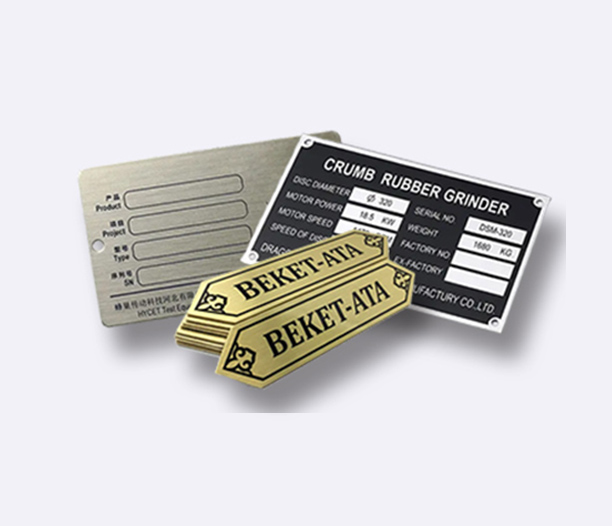
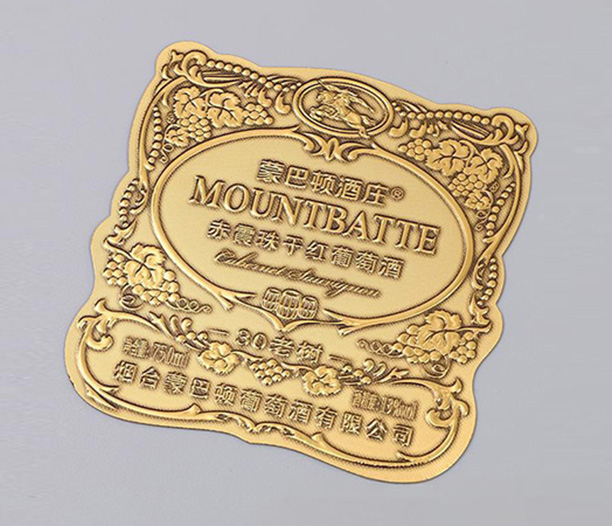
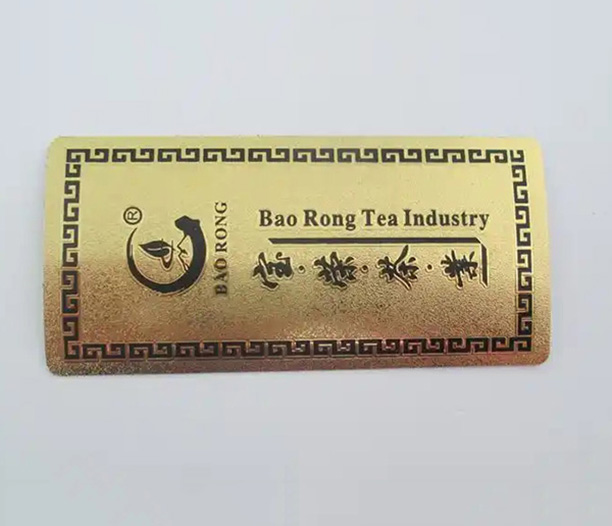
Engineering Durable Machine Name Plates: Standards, Materials, and Lifecycle Compliance | HemawellIn industrial environments, the machine name plates serve a function far beyond simple branding. They are legally mandated identification systems that communicate critical data—serial numbers, voltage ratings, operating pressures, and safety certifications—directly to operators, maintenance crews, and regulatory inspectors. Failure of these identification components due to chemical exposure, abrasion, or high temperatures can lead to safety violations, extended downtime, and costly equipment recalls. At Hemawell Nameplate, we approach the production of industrial machine name plates not as a commodity service, but as an exercise in precision engineering, where material selection, manufacturing processes, and testing protocols are calibrated to the specific operational environment of the machinery.
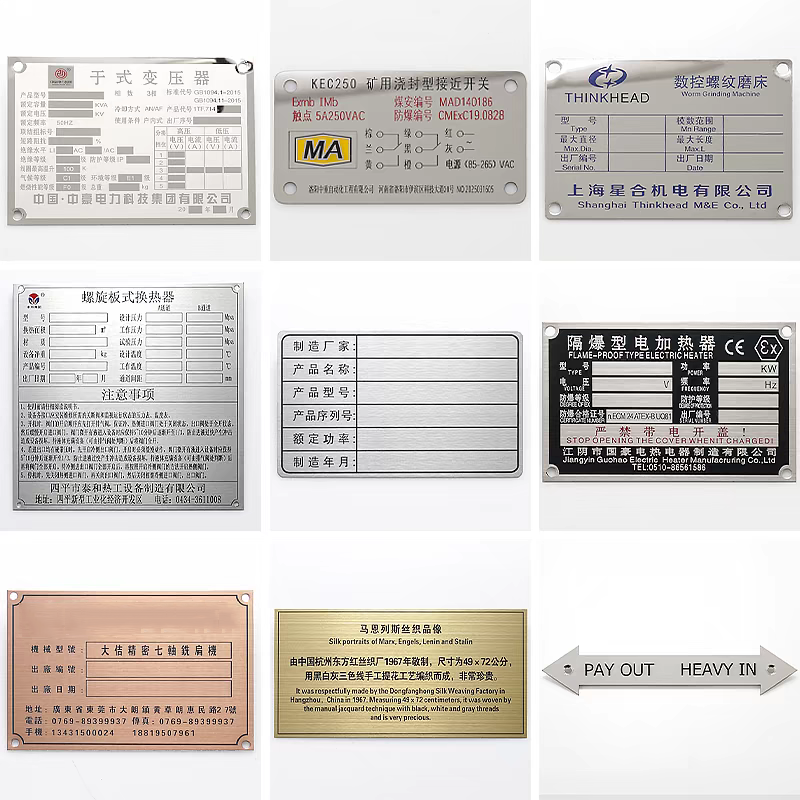
1. Defining Technical Requirements for Industrial Identification
The specification of durable machine name plates begins with a rigorous analysis of the operating environment. Unlike consumer-grade labels, these plates must maintain legibility and adhesion under conditions that include sustained vibration, thermal cycling from -40°C to over 150°C, hydraulic fluid immersion, and UV radiation. The technical foundation rests on three pillars: substrate material, marking permanence, and mounting integrity.
1.1 Substrate Selection: From Anodized Aluminum to High-Temperature Polyimides
For the majority of heavy machinery, anodized aluminum remains the benchmark for machine name plates. Aluminum grade 5052-H32 offers an optimal balance of corrosion resistance, formability, and cost-effectiveness. However, for equipment exposed to aggressive solvents or salt-laden atmospheres (offshore platforms, marine propulsion), we specify stainless steel 316L or specialized nickel alloys. In scenarios where weight reduction is critical—such as aerospace ground support equipment—titanium plates with photo-etched markings are employed. For applications requiring electrical insulation or extreme thermal stability, polyimide-based substrates (rated for continuous operation at 240°C) provide a non-conductive alternative that meets UL 94 V-0 flammability standards.
1.2 Permanence of Markings: Mechanical vs. Chemical Bonding
Critical data on machine name plates must resist obliteration. Traditional silk screening is unsuitable for high-wear zones because the ink remains on the surface. Instead, we utilize two high-integrity methods:
Photo-chemical etching: Produces recessed characters that are filled with epoxy-based enamel. The recess depth (typically 0.15mm to 0.3mm) protects the marking from mechanical abrasion, ensuring that even after decades of service, the data remains readable.
Laser marking with oxide transformation: For stainless steel and titanium plates, fiber lasers create permanent markings by altering the surface oxide layer. This method produces high-contrast, corrosion-resistant serial numbers and barcodes that cannot be removed without destroying the base material.
2. Addressing Industry-Specific Pain Points Through Engineered Nameplates
Procurement engineers and plant managers consistently report failures with standard identification solutions. Common issues include adhesive breakdown under high heat, illegible markings after chemical cleaning, and delamination in high-humidity environments. A properly specified machine name plate eliminates these operational risks through design choices that anticipate the full lifecycle of the equipment.
2.1 Case Study: Hydraulic Press Manufacturer – Chemical Resistance
A manufacturer of hydraulic presses was experiencing failure rates of 15% on their nameplates within the first year of service, due to exposure to hydraulic fluid and industrial degreasers. The standard anodized plates with screen-printed graphics showed fading and adhesive creep. We redesigned the machine name plates using 0.8mm 316L stainless steel, photo-etched to a depth of 0.25mm, and filled with a two-part epoxy certified for immersion in Skydrol and petroleum-based fluids. The plates were attached using aerospace-grade acrylic foam tape (with a shear strength exceeding 200 psi) rather than mechanical fasteners that could create crevice corrosion points. After 36 months of field testing, zero failures were recorded, and the marking contrast remained within original tolerances.
2.2 Compliance in Explosive Environments (ATEX / IECEx)
For equipment deployed in potentially explosive atmospheres, regulatory bodies mandate that machine name plates be constructed from non-sparking materials and that all markings remain legible for the equipment’s certified life. We produce plates specifically for Zone 1 and Zone 2 environments using bronze, brass, or specialized aluminum-silicon alloys. The marking process uses deep mechanical engraving rather than laser marking in these cases, to avoid any thermal alteration that could compromise the material’s intrinsic safety rating. Each plate is serialized and traceable to raw material certifications, ensuring full compliance with ATEX Directive 2014/34/EU.
3. Manufacturing Workflow: From Engineering to Validation
Producing high-reliability machine name plates requires a structured manufacturing process that integrates design validation with statistical process control. Our standard protocol at Hemawell Nameplate is built on four distinct phases, ensuring that each plate meets the specific demands of its intended application.
Phase 1 – Engineering & Artwork Validation: We begin by analyzing the customer’s CAD data and operational specifications. Using thermal simulation software, we evaluate the coefficient of thermal expansion (CTE) mismatch between the nameplate material and the mounting surface. For plates exceeding 200mm in length, we incorporate slotted mounting holes to accommodate differential expansion, preventing warping or fastener shear.
Phase 2 – Tooling & Process Definition: For etched or embossed plates, we fabricate precision tooling with tolerances of ±0.05mm. For screen-printed plates requiring high-definition graphics (such as logos with fine detail), we use 350-mesh stainless steel screens and UV-curable inks that achieve a film thickness of 25-30 microns, providing both durability and resolution.
Phase 3 – Production & In-Process Controls: Throughout production, we conduct real-time SPC (Statistical Process Control) on critical parameters: for etching, we monitor bath temperature and immersion time to maintain consistent depth; for printing, we track viscosity and cure temperatures. Each parameter is recorded against the job’s control plan.
Phase 4 – Post-Processing & Protective Coatings: To extend service life, we apply additional protective layers based on the environment. For outdoor equipment, we use a clear anodized coating (MIL-A-8625 Type II) with a thickness of 10-15 microns. For chemical exposure, we apply a ceramic-based clear coat that provides resistance to pH ranges from 2 to 12.
4. Economic Lifecycle Analysis: Total Cost of Ownership (TCO)
While the initial procurement cost of a high-quality machine name plate may be higher than that of a basic adhesive label, the total cost of ownership analysis demonstrates significant long-term savings. Factors considered in our TCO model include:
Downtime costs: A failed nameplate often necessitates equipment shutdown for replacement or recertification. For manufacturing lines valued at $10,000 per hour of downtime, preventing a single failure justifies a 500% increase in nameplate expenditure.
Regulatory penalties: In industries such as oil & gas, non-compliant or illegible identification can result in citations exceeding $100,000 per incident.
Warranty disputes: Illegible serial numbers complicate warranty claims and can lead to premature component replacement, inflating service costs.
By integrating a durable machine name plate designed for the specific application, OEMs and asset owners eliminate recurring replacement cycles and mitigate compliance risks, achieving a net reduction in lifecycle costs of 40-60% compared to using commercial-grade alternatives.
5. Quality Assurance and Testing Protocols
Our commitment to E-E-A-T principles is demonstrated through our comprehensive testing regime, which goes far beyond visual inspection. Each batch of machine name plates undergoes a series of validation tests that mirror the most extreme conditions the equipment will encounter.
Thermal Cycling: Plates are subjected to 100 cycles between -40°C and +150°C, with a dwell time of 30 minutes at each extreme. After cycling, we inspect for adhesion loss, color change, and legibility using 10x magnification.
Chemical Resistance: Samples are immersed in a panel of fluids representative of the target industry—including mineral oils, brake fluids, sulfuric acid (10% concentration), and saline solutions—for 72 hours. We use a 0-5 rating scale to quantify any degradation in marking or substrate.
Mechanical Durability: For plates subject to frequent cleaning or impact, we perform Taber abrasion testing (ASTM D4060) using CS-10 wheels with a 500g load for 500 cycles. Legibility must remain unchanged, with no exposure of the underlying metal.
Adhesion Testing: For plates using pressure-sensitive adhesives, we conduct peel adhesion tests (ASTM D3330) and shear tests at elevated temperatures to validate mounting security.
6. Advanced Customization: Integrating RFID and Barcode Technologies
The modern industrial environment demands that machine name plates function as data carriers within the broader ecosystem of Industry 4.0. We frequently integrate passive RFID (Radio-Frequency Identification) inlays into metal nameplates, allowing for non-line-of-sight asset tracking. The technical challenge lies in mitigating the interference caused by the metal substrate. Our solution involves using ferrite-backed RFID tags or creating a recessed pocket in the nameplate that holds an encapsulated inlay, maintaining read ranges of 1-2 meters despite the metal mounting surface. This integration turns a static identification plate into a dynamic asset management node, enabling automated maintenance logging, location tracking, and inventory control directly from the equipment floor.
7. Expert Perspective: The Critical Role of Surface Preparation
One of the most overlooked factors in the longevity of machine name plates is surface preparation prior to marking or adhesion. For any plate that receives a coating, printing, or adhesive, we mandate a multi-stage cleaning process: alkaline degreasing to remove fabrication oils, followed by a deionized water rinse, and finally a plasma treatment to increase surface energy. This ensures that the surface tension of the substrate exceeds 72 dynes/cm, which is the minimum threshold for reliable adhesion of industrial epoxies and inks. Without this level of preparation, even the most sophisticated materials will experience premature delamination. This step is particularly critical for plates destined for high-humidity environments where osmotic blistering can occur if contaminants are trapped beneath the coating.
Conclusion: The Strategic Value of Engineered Nameplates
In the context of industrial asset management, machine name plates are not merely accessories; they are critical documentation points that enable safe operation, regulatory compliance, and efficient maintenance. By treating these plates as engineered components—with the same rigor applied to bearings or seals—manufacturers can significantly reduce operational risks and lifecycle costs. At Hemawell Nameplate, our process integrates material science, precision manufacturing, and rigorous validation to deliver identification solutions that perform reliably in the most demanding environments. The shift toward durable, integrated identification is a fundamental aspect of modern industrial design, ensuring that critical data remains accessible for the entire service life of the equipment.
Frequently Asked Questions (FAQ) About Machine Name Plates
Q1: What materials are best for machine name plates used in outdoor or corrosive environments?
A1: For outdoor applications with exposure to UV, moisture, and temperature swings, anodized aluminum (5052 or 6061) with photo-etched or laser-marked graphics is the standard. For corrosive environments such as chemical plants or marine settings, 316L stainless steel or specialized alloys (e.g., Hastelloy) are recommended due to their superior resistance to chlorides and acids. The marking method should be mechanical (etching or embossing) to preserve integrity if the surface coating is compromised.
Q2: How do I ensure compliance with UL or CSA requirements for electrical equipment nameplates?
A2: For electrical enclosures and control panels, nameplates must meet UL 969 (Marking and Labeling Systems) or CSA C22.2 No. 0.15. Compliance requires using certified materials (substrates and adhesives) that have undergone testing for temperature rating, flammability, and adhesion. We provide full traceability documentation and can produce plates with the required UL Recognized Component Mark. It is essential that the adhesive is rated for the maximum operating temperature of the equipment, typically 90°C to 150°C depending on the application.
Q3: What is the typical lead time for custom-engineered machine name plates, and what information is required to start?
A3: Lead times vary based on complexity and quantity. For standard materials and processes (anodized aluminum with screen printing), lead times are typically 10-14 business days after artwork approval. For more complex projects involving special alloys, embossing, or integrated RFID, allow 3-4 weeks for tooling and validation. To initiate a project, we require a dimensioned drawing (or CAD file), the specified material and finish, the environmental conditions (temperature range, chemical exposure), and the artwork in vector format (AI or EPS).
Q4: Can machine name plates be made with variable data, such as unique serial numbers or QR codes, without significantly increasing cost?
A4: Yes. We utilize digital printing and laser marking to apply variable data efficiently. For quantities exceeding 500 units, we can integrate laser marking into the production line, allowing each plate to receive a unique serial number, barcode, or QR code with no setup time between units. This is done after the base graphics (logo, warnings) are applied, ensuring that variable data is added without affecting the primary markings. The cost impact is minimal, typically adding 5-10% to the unit cost depending on complexity.
Q5: What mounting methods are recommended for machine name plates in high-vibration environments (e.g., engines, compressors)?
A5: For high-vibration environments, mechanical fasteners (stainless steel rivets or tamper-proof screws) are the most reliable. When using adhesives, we specify high-performance acrylic foam tapes (such as 3M VHB) that are designed to absorb vibrational energy. The tape must be applied to a clean, properly prepared surface, and we recommend using a primer for non-metallic substrates. For plates larger than 100cm², we often combine a perimeter of adhesive with one or two mechanical fasteners to ensure security against both vibration and potential impact.