Ultimate Guide to Equipment Asset Tags: Durability, Compliance & Smart TrackingIn today's competitive industrial landscape, effective asset management is no longer a back-office function—it's a strategic imperative. At the heart of every robust asset tracking system lies a simple yet critical component: equipment asset tags. These tags serve as the physical link between your machinery and your digital records, enabling precise inventory control, predictive maintenance, and regulatory compliance. According to a 2023 report by Zebra Technologies, organizations using automated asset tracking reduce asset search time by up to 40% and lower capital expenditure by 15%. However, the benefits are only realized if the tags themselves can survive the rigors of your specific environment. This guide delves deep into the engineering, materials, and selection criteria for modern equipment asset tags, ensuring your tracking investment delivers maximum ROI.
1. What Are Equipment Asset Tags? Beyond Basic Identification
Equipment asset tags are specialized labels or plaques designed to be permanently attached to physical assets—from laptop computers to offshore drilling rigs. Unlike standard paper labels, they incorporate durable materials, advanced adhesives, and data-encoding technologies (barcode, QR code, RFID, NFC) to withstand harsh conditions while providing machine-readable identification. They form the cornerstone of an asset lifecycle management (ALM) system, enabling organizations to track location, maintenance history, warranty status, and depreciation in real time.
Function: Unique identification, data capture, and integration with CMMS/EAM software.
Key difference from ordinary labels: Engineered for longevity, environmental resistance, and data density.
2. Material Science and Durability: The Backbone of Asset Tags
The choice of material determines whether an asset tag will last five years or five weeks in your operating environment. Industrial settings often involve extreme temperatures, chemicals, abrasion, and UV exposure.
2.1 Metal Asset Tags: Anodized Aluminum and Stainless Steel
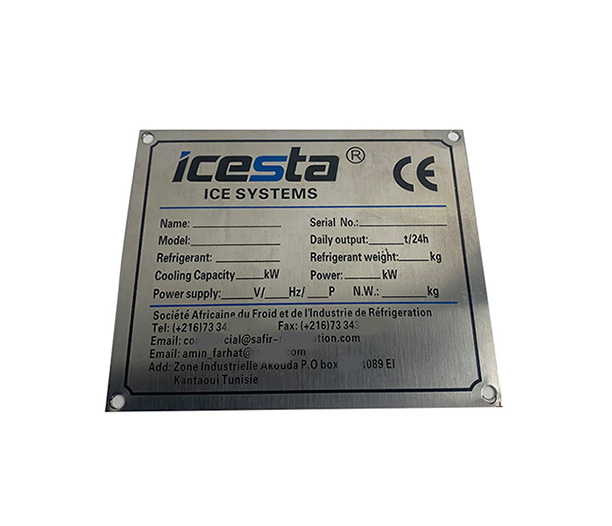
For heavy machinery, oil & gas, and outdoor infrastructure, metal tags are the gold standard. Anodized aluminum offers corrosion resistance, lightweight strength, and the ability to be laser-etched or photo-anodized for high-contrast images. It withstands -80°F to +500°F. Stainless steel (304 or 316) is chosen for marine environments or chemical plants due to its superior resistance to salt spray and acids. Metal equipment asset tags can be attached via rivets, screws, or high-strength adhesives.
2.2 Industrial Polyester and Polyimide Films
When flexibility and thinness are required—such as on electronic equipment, hand tools, or curved surfaces—polyester (PET) and polyimide (PI) films are ideal. Polyester tags with a matte white finish provide excellent contrast for barcodes and resist temperatures up to 300°F. Polyimide is essential for printed circuit board (PCB) tracking, surviving wave soldering and reflow processes. These materials are often laminated with a clear protective layer to enhance abrasion and chemical resistance.
2.3 Tamper-Evident and Destructible Vinyl
For IT assets, rental equipment, or sensitive inventory, tamper-evident tags are crucial. These are made from fragile vinyl that fractures upon removal, leaving a "void" pattern. They deter theft and unauthorized swapping. Some designs incorporate custom laser-cut slits that make transfer impossible without visible damage.
3. Adhesive Technologies: Ensuring Permanent Attachment
Even the most durable face material will fail if the adhesive doesn't bond securely to the asset surface. The wrong adhesive can lead to "flagging" (edges lifting) or complete tag loss, resulting in broken data chains.
3.1 High-Performance Acrylic Adhesives
Acrylic-based adhesives provide excellent long-term aging, UV stability, and resistance to plasticizers. They are suitable for most smooth surfaces like powder-coated metal, glass, and painted surfaces. Temperature range: -40°F to +250°F. Common in HVAC, electrical panels, and automotive applications.
3.2 Rubber-Based Adhesives for Low-Surface-Energy Plastics
Polyethylene, polypropylene, and some textured powder coatings have low surface energy, making bonding difficult. Rubber-based adhesives offer high initial tack and conformability. They are often used on plastic totes, chemical containers, and outdoor power equipment. However, they may be less UV-resistant than acrylics unless specially formulated.
3.3 Extreme Environment Adhesives
For aerospace, downhole drilling, or cryogenic storage, specialized adhesives like epoxy or silicone are required. These can withstand jet fuel, hydraulic fluids, and temperatures from -320°F to +600°F. When specifying equipment asset tags for such conditions, consult with a materials engineer to validate compatibility.
4. Data Encoding: Barcodes, QR Codes, RFID, and NFC
The core purpose of an asset tag is to encode a unique identifier that can be read by scanners or mobile devices. The choice of encoding technology impacts scan speed, data capacity, and automation level.
4.1 Linear Barcodes (Code 39, Code 128)
The most widely used format for asset tracking. They are inexpensive to print and require only a laser or CCD scanner. However, they have limited data capacity and must be within line of sight. For many manufacturing and warehousing applications, 1D barcodes on durable polyester tags remain a cost-effective solution.
4.2 2D Data Matrix and QR Codes
Two-dimensional codes pack more information—such as serial number, model, and URL—into a small space. Data Matrix is preferred in automotive and aerospace (often mandated by UID standards) due to its high error correction. QR codes are popular for consumer-facing assets but are increasingly used internally for quick access to maintenance records via smartphones.
4.3 RFID and NFC Tags
Radio-frequency identification (RFID) enables batch scanning without line of sight. Passive UHF RFID tags (RAIN RFID) can be read from 20+ feet away, making them ideal for warehouse portals and inventory cycles. NFC tags (High Frequency) have shorter range (a few inches) but can be read by any NFC-enabled phone, perfect for commissioning and service tasks. Embedding an RFID inlay into a rugged equipment asset tag combines durability with automation—critical for Industry 4.0 initiatives.
5. Industry-Specific Applications and Compliance Mandates
Different sectors impose unique requirements on asset tags. Below we examine four high-stakes environments.
5.1 Healthcare and Medical Devices
Hospitals track thousands of assets—ventilators, infusion pumps, wheelchairs—to improve utilization and meet regulatory standards (e.g., FDA UDI). Tags must withstand repeated cleaning with harsh disinfectants (bleach, quaternary ammonium). Polyester or polypropylene tags with an aggressive permanent adhesive and a glossy overlaminate are common. For surgical instruments, laser-marked stainless steel tags survive autoclave sterilization and are compliant with AAMI standards.
5.2 Manufacturing and Industrial Automation
In factories, asset tags are applied to motors, conveyors, robots, and tooling. They must resist oils, coolants, and high temperatures. Barcode or RFID tags help integrate with Manufacturing Execution Systems (MES) for real-time work-in-progress tracking. Some manufacturers use high-temperature polyimide tags that can be applied directly to hot surfaces (up to 600°F).
5.3 Oil & Gas and Chemical Processing
Tags on pipelines, valves, and offshore platforms face salt spray, hydrocarbons, and fire hazards. Metal tags with photo-anodized or laser-etched markings are mandatory. Some applications require "fire-safe" tags that remain legible after direct flame exposure per ISO 14557. Equipment asset tags in this sector often incorporate stainless steel wire or cable ties for secure attachment.
5.4 IT and Data Center Asset Management
Servers, switches, and storage arrays need small, tamper-evident tags that do not interfere with airflow. Destructible vinyl or polyester tags with pre-printed barcodes and company logos are standard. RFID tags embedded in the bezel allow rapid data center audits—some hyperscale data centers report inventory time reduced from weeks to hours using RFID portals.
6. Calculating the ROI of High-Quality Asset Tags
Investing in premium equipment asset tags yields measurable financial returns. A study by the Aberdeen Group found that best-in-class organizations achieve 98% asset tracking accuracy, compared to 84% for laggards. The tangible benefits include:
Reduced lost assets: Companies lose 5–10% of their assets annually due to misplacement or theft. Durable tags combined with regular scans can cut this loss by 70%.
Lower maintenance costs: Accurate tracking ensures preventive maintenance is performed on schedule, reducing unplanned downtime by 20–30%.
Improved compliance: Avoid fines from regulatory bodies (OSHA, FDA, EPA) by having verifiable inspection records attached to each asset.
Faster audits: With RFID tags, physical inventory counts can be completed 80% faster.
To choose the optimal tag for your application, follow this systematic approach:
Assess the environment: Temperature range, chemical exposure, UV, abrasion, washdown frequency.
Evaluate the surface: Material (metal, plastic, painted), texture, curvature, and cleanliness.
Define data requirements: Static ID only, variable data, RFID read range, memory size.
Consider attachment method: Adhesive, mechanical (rivets, screws), cable ties, or embedded.
Verify compliance: UL, CSA, MIL-STD, FDA, etc.
Test, test, test: Request samples and conduct field trials under actual conditions.
8. Future Trends: Smart Tags and IIoT Integration
The next generation of equipment asset tags is evolving into intelligent sensors. RFID tags with embedded temperature, humidity, or shock sensors can transmit condition data along with identity. For example, a smart tag on a refrigerated container can log temperature excursions during transit, ensuring cold chain integrity. BLE (Bluetooth Low Energy) tags allow real-time location tracking within facilities, enabling dynamic asset utilization analytics. As the Industrial Internet of Things (IIoT) expands, asset tags will become nodes in a digital twin, feeding data into predictive maintenance algorithms and optimizing asset lifecycle decisions.
Conclusion: Strategic Investment in Asset Visibility
Equipment asset tags are far more than stickers—they are enablers of operational excellence. By selecting tags engineered for your specific environment and encoding requirements, you lay the foundation for accurate, automated asset management. Whether you need metal tags for offshore platforms or RFID-enabled labels for data centers, partnering with a knowledgeable supplier ensures that your asset tags deliver reliable performance for years to come. In an era where every asset must be accounted for, the right tag is the first step toward total visibility and control.
Frequently Asked Questions About Equipment Asset Tags
Q1: What is the most durable material for equipment asset tags used outdoors in direct sunlight?
A1: For prolonged UV exposure, anodized aluminum or stainless steel with laser etching offers the longest life. If you need a flexible tag, 2-mil polyester with a UV-resistant overlaminate and an acrylic adhesive is recommended. Always verify with accelerated weathering tests (ASTM G154).
Q2: Can asset tags be applied to curved or irregular surfaces?
A2: Yes, flexible materials like polyester and vinyl conform well to curved surfaces. For tight radii, consider thinner films (1 mil) and adhesives with high initial tack. Metal tags can be curved during manufacturing or attached with rivets/straps that follow the contour.
Q3: How do I ensure the barcode on an asset tag remains scannable over time?
A3: Choose a high-contrast face material (white matte) and a resin-based thermal transfer ribbon. Protect the print with a clear overlaminate. For metal tags, direct laser marking (dark on light background) creates an indelible high-grade barcode. Periodic verification with a barcode verifier ensures compliance with ISO/IEC standards.
Q4: Are there equipment asset tags that incorporate both barcode and RFID in one device?
A4: Yes, hybrid tags are common. They combine a printed barcode (visual backup) with an embedded RFID inlay. This is useful in environments where some locations have RFID readers while others rely on handheld barcode scanning. The inlay is typically laminated between polyester layers for durability.
Q5: What is the typical lifespan of an industrial asset tag?
A5: With proper material selection, a quality asset tag can last 5–10 years or more. Polyester tags with resin ribbons and overlaminate indoors can exceed 10 years. Metal tags can last the life of the asset (20+ years). The adhesive bond should outlast the face material.
Q6: Can you provide custom-printed asset tags with sequential numbers and company logos?
A6: Absolutely. Most converters offer thermal transfer or digital printing for variable data—sequential barcodes, serial numbers, and logos. For high volumes, flexographic printing provides consistent color and cost efficiency. Be sure to specify any required compliance marks (CE, UL, etc.) when ordering.
Q7: Do asset tags withstand chemical cleaning agents in pharmaceutical environments?
A7: Yes, but you must specify the exact chemicals. Polyester with a chemical-resistant overlaminate can withstand many solvents, including IPA, bleach, and hydrogen peroxide. For aggressive solvents like MEK or acetone, consider laser-marked stainless steel or ceramic-coated aluminum tags.